


CFU/g Explained: Why Label Claims and Actual Counts Differ
Your ETP is running, the dosing schedule is locked in, and you’ve ordered bioculture with a CFU count that your calculations say should handle the organic load comfortably. The CPCB inspection is scheduled for next week. BOD should be within limits. COD should be fine. Then the effluent quality data comes back, BOD is climbing, TSS is spiking, and your aeration basin looks like it’s struggling to keep up.
You did everything right. Or did you?
The CFU count bioculture label claimed a specific number. What actually reached your aeration basin was, in all likelihood, a fraction of that. This isn’t fraud. It’s not a supplier conspiracy. It’s science, and understanding it is the difference between a plant manager who just doses and hopes, and one who doses with precision.
This is the gap that sits at the heart of most unexplained biological treatment failures in Indian industrial ETPs and STPs. The CFU/g number on a bioculture label represents a specific measurement taken under controlled laboratory conditions at the time of manufacture. By the time that product reaches your dosing point, the viable count has almost certainly declined, sometimes marginally, sometimes catastrophically, depending on how the product was stored, transported, aged, and applied.
If you are evaluating bioculture suppliers right now, the first thing to ask is not what CFU/g they claim. It is whether they can provide verified viable count data lot by lot, on the finished formulated product, with documentation covering storage conditions from dispatch to delivery. Our technical team at Team One Biotech provides exactly this. But before you make that call, read this article, because informed procurement starts with understanding what CFU/g actually measures and, more importantly, what it does not.
What CFU/g Actually Means, And What It Does Not

CFU stands for Colony Forming Unit. The number printed as CFU per gram bacteria on a product label tells you how many bacteria in one gram of that product were capable of forming a visible colony on an agar plate, under specific laboratory conditions, at the time that sample was tested.
The methodology behind this number is called the plate count method. A small sample of the bioculture is taken, diluted in a buffer solution through a series of controlled steps, spread across nutrient agar plates, and incubated at a defined temperature for a defined period. The colonies that grow are counted. That count, extrapolated back through the dilution factor, gives the CFU/g figure.
This is a useful scientific measurement. But it has important limitations that every procurement manager and plant engineer should understand before they base a dosing decision on it.
First, it is a snapshot. It captures the viable count at a single point in time, the time of testing, which may have been days or weeks before the product was packaged, and weeks or months before it arrives at your facility.
Second, it measures viability under laboratory conditions, the right temperature, the right nutrient medium, the right incubation environment. Those conditions are not your aeration basin. The plate count method tells you how many bacteria could survive in a lab. It does not tell you how many will survive your storage conditions, your transit chain, your carrier matrix, and your dosing protocol.
Third, the distinction between total count and viable count matters enormously in practice. Total count includes cells that are present but metabolically inactive or dead. Viable count, what CFU actually measures, is the number capable of activity under a specified set of conditions. But even within viable count, there is a further distinction between spore-forming bacteria that are dormant but potentially activatable, and vegetative cells that are immediately metabolically active. A label CFU/g does not always tell you which you are getting.
Note: The CFU ranges and general observations in this article are indicative and based on broad industry experience. Actual values vary significantly depending on the bioculture formulation, carrier type, target application, and your specific ETP or STP operating conditions. Always request and refer to the manufacturer’s lot-specific data for procurement and dosing decisions.
Five Reasons Your Bioculture’s CFU Count Drops Before It Reaches Your Aeration Basin
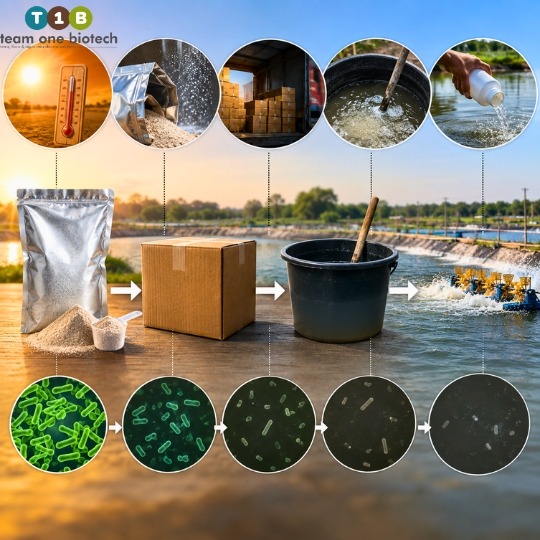
This is where the gap between the label and the reality is created. Not by dishonesty, but by physics, chemistry, and the realities of the Indian industrial supply chain. Each of the following factors independently reduces the viable count that reaches your dosing point. Together, they can reduce it dramatically.
1. Storage Temperature Violations During Transit and Warehousing
Most biocultures, particularly those containing active vegetative cells, have a defined and narrow temperature window within which viability is maintained. The CFU/g claim on the label was measured under controlled laboratory storage conditions. What happens to that count during three days on a truck crossing Maharashtra in June, or sitting on a non-refrigerated shelf in a regional distributor’s go-down, is a different matter entirely.
Bacterial cell membranes are highly sensitive to temperature. Vegetative cells exposed to temperatures above their survivable range do not just stop multiplying, they die, and that loss is irreversible. Even moderate temperature excursions sustained over time cause cumulative, progressive cell death.
The practical implication for plant managers is this: always ask your bioculture supplier for documentation of storage conditions from the point of dispatch to the point of delivery. Ask whether they have cold chain protocols in place and how they verify compliance at the distributor level. A supplier who cannot answer this question specifically is a supplier who cannot guarantee what CFU/g is actually reaching you.
2. Shelf-Life Degradation and the Dead Zone Near Expiry
All biocultures have a shelf life. But here is what most procurement decisions fail to account for: the decline in viable count is not linear. It is accelerating. A product may hold its viable count relatively well through the first half of its shelf life and then drop sharply as it approaches expiry.
This means that a product with three months remaining on its label may carry a viable count that is already far below its day-one specification, not because the product is defective, but because that is the nature of biological decay. Shelf-life is a safety boundary, not a performance guarantee across its entire range.
Procurement decisions driven primarily by price frequently result in the purchase of products with shorter remaining shelf life, often because older stock is discounted. This is a false economy. The cost saving on the purchase order is recovered and then some in the form of under-dosed aeration basins, extended treatment failures, and the cost of remediation when effluent quality falls outside CPCB or SPCB discharge norms.
The implication: always request the manufacturing date, not just the expiry date. Calculate the age of the product at the point of expected use, not at the point of delivery. Then compare that against the supplier’s shelf-life curve data, which should show you how viable count declines over time, not just where the cut-off is.
3. Carrier Substrate Interference During Plate Counting
Industrial biocultures are almost never pure bacterial cultures. They are formulated products, bacteria blended with a carrier substrate such as talc, vermiculite, activated charcoal, lignite, or a similar material. This carrier serves important functions: it protects cells during storage, provides a physical matrix for adhesion, and supports gradual release into the treatment environment.
But carriers create a measurement problem. Standard plate count methodology is designed for aqueous suspensions of bacteria. When you introduce a carrier substrate, particularly an absorbent or reactive one, into the counting process, it can interfere with dilution accuracy, colony spreading, and even nutrient availability on the agar plate. The result is that CFU/g counts taken on formulated carrier-blended products can be systematically different from counts taken on the raw bacterial concentrate before blending.
Here is the problem from a procurement standpoint: a label CFU/g may reflect the count measured on the raw concentrate before carrier blending, not on the finished product that you actually purchase and dose. This is a significant distinction. If a manufacturer measures CFU/g before blending and then quotes that number on the final product label, you are not receiving an accurate picture of the viable count per gram of what is actually in the bag.
The question to ask your supplier is direct: is your label CFU/g measured on the raw culture concentrate, or on the finished carrier-blended formulation? Only the latter is meaningful for your dosing calculations.
4. Spore Count vs. Active Vegetative Cell Count, The Hidden Mismatch
Many biocultures used in industrial wastewater treatment are built around spore-forming bacteria, most commonly Bacillus species and their relatives. Spores are extraordinarily stable, highly resistant to temperature fluctuation, UV, desiccation, and other environmental stresses. From a shelf life and storage perspective, spore-based biocultures are far more robust than those based on vegetative cells.
But spores are dormant. They are not biologically active in the way that vegetative cells are. A spore sitting in your aeration basin is not reducing BOD. It is not breaking down organic compounds. It is waiting. For it to contribute to treatment, it must first germinate, transition from its dormant spore state into an active vegetative cell. Germination requires specific triggering conditions: the right temperature range, adequate dissolved oxygen levels, sufficient nutrient availability, and an appropriate pH window.
If your label CFU/g reflects a spore-based count, and your aeration basin conditions are not consistently conducive to rapid germination, then the biology you dosed is not working. You have effectively added dormant biomass and expected active treatment. The two are not the same thing.
This distinction matters particularly for systems that need fast biological response, after a toxic shock loading event, during a plant start-up, or when recovering from a microbial inventory crash. In those situations, a vegetative cell count matters far more than a spore count, even if the spore count is higher.
The implication: know whether your bioculture is spore-based or vegetative-cell-based, or a blend of both. Request clarity on what the label CFU/g actually represents in terms of cell state. And ensure that your aeration basin conditions are set up to support germination if you are working with a spore-dominant formulation.
5. Post-Dilution and Dosing Method Losses
The final stage at which viable count is lost is the dosing process itself. The bacteria that survived manufacture, storage, transit, and three months on a shelf now face their last challenge: the way in which you mix, dilute, and introduce them to the treatment system.
High-shear mixing during reconstitution physically damages bacterial cell membranes. Chlorinated make-up water, tap water used directly for dilution without dechlorination, is actively bactericidal. Dosing directly into zones with extreme pH, high ammonia concentration, or ongoing shock loading from a slug of toxic industrial effluent can kill a significant fraction of introduced bacteria before they have an opportunity to colonize the reactor.
None of these losses are reflected in the label CFU/g. The label assumes that you will follow the manufacturer’s recommended application protocol precisely, that you will use dechlorinated water at the correct temperature, that you will mix gently and allow appropriate contact time, and that you will dose into a zone of the basin where conditions are compatible with bacterial survival.
Many field applications do not follow these protocols, either because the information was never communicated clearly or because site conditions make it difficult. The result is that a product that already arrived at a reduced viable count is further depleted during dosing.
The implication: request and follow the product’s dosing and application protocol as a standard part of your procurement documentation. Pre-condition bacteria in dechlorinated water at the appropriate temperature before they reach the aeration basin. Identify the most biologically compatible dosing point in your treatment system.
Why This Gap Has Direct Compliance Consequences

The five reasons above are not academic. They connect directly to the numbers that determine whether your facility passes or fails a CPCB or SPCB inspection.
Your aeration basin’s biological treatment capacity is built on a specific microbial inventory. That inventory, measured practically as MLVSS, or Mixed Liquor Volatile Suspended Solids, needs to be maintained above a threshold level to achieve the BOD, COD, and TSS reductions required by your discharge norms. When you add bioculture, you are seeding that inventory. Your dosing calculation assumes you are delivering a specific number of viable organisms per dosing event.
If the actual viable count delivered is significantly lower than the label suggests, because of any combination of the five factors above, your aeration basin is under-seeded. An under-seeded basin does not fail immediately and visibly. It underperforms gradually. Treatment efficiency declines. Effluent quality drifts toward the boundary of compliance. And then, during a high organic load event or a change in influent characteristics, it tips over.
The recovery time for an under-seeded biological system can range from days to weeks depending on how far the MLVSS has dropped and what the system’s operational conditions allow. During that recovery window, your effluent quality is compromised. If a CPCB or SPCB monitoring event falls in that window, the consequences are professional and legal, not just operational.
This is why CFU/g is not a label specification issue. It is a compliance risk management issue.
Team One Biotech supplies a lot-specific Certificate of Analysis with every batch, confirming viable count on the finished carrier-blended product alongside spore count and activity confirmation. This is what taking the guesswork out of biological compliance looks like. Request your product datasheet and COA format from our team today.
What to Demand from Your Bioculture Supplier, A Procurement Checklist

Use this checklist in your next supplier evaluation conversation:
- Lot-specific Certificate of Analysis with viable count measured on the finished carrier-blended product, not the raw concentrate
- Manufacturing date and batch traceability, not just expiry date
- Storage condition documentation with evidence of cold chain compliance from dispatch to delivery
- Clarification on CFU/g composition, whether the stated count reflects spore count, vegetative count, or a combined total
- Dosing protocol documentation including recommended pre-conditioning steps, appropriate make-up water specifications, and optimal dosing point guidance
- Shelf-life curve data showing the decline in viable count over the product’s shelf life, not just the expiry boundary
- Access to application support from a technical team capable of helping you build a dosing calculation that reflects real-world viability for your specific ETP volume, HRT, and organic loading conditions
Any supplier who cannot provide clear documentation on each of these points is asking you to trust a label. In a regulated industrial environment with CPCB and SPCB obligations, trusting a label is not a strategy.
Frequently Asked Questions
What is a good CFU/g count for a wastewater bioculture?
There is no universal answer, the appropriate CFU/g depends on your aeration basin volume, hydraulic retention time, organic loading rate, and target treatment parameters. What matters is that the verified viable count delivered to your system matches your dosing calculation, not what is printed on the label. Always work from lot-specific COA data and consult your supplier’s technical team for application-specific guidance.
How do I verify the CFU count of a bioculture I have purchased?
Request a third-party plate count on a representative sample from your delivered lot. Ensure the laboratory uses dilution and incubation conditions appropriate for the specific genera present in your product. Compare the result against the manufacturer’s lot-specific COA. Systematic discrepancies between independent testing and the manufacturer’s COA are a signal worth investigating.
Can I mix biocultures from two different suppliers to compensate for low viable counts?
This is generally not recommended without explicit technical guidance. Bacterial consortia from different manufacturers may be built around competing or incompatible organisms. Carrier and pH incompatibilities can further reduce effective viability when products are combined. If you are experiencing chronic shortfalls in viable count delivery, the correct response is to address the supply chain or product quality issue, not to blend products.
How does CFU/g relate to MLSS and MLVSS in my aeration basin?
CFU/g describes the seeding density of the inoculum you are adding. MLSS and MLVSS measure the total and volatile suspended solids in your mixed liquor, the entire biological community in the basin, including both the organisms you introduced and those that developed indigenously. A high-quality, high-viable-count inoculation accelerates the buildup of biologically active MLVSS, which is the functional measure of your basin’s treatment capacity.
Does refrigerated storage always preserve CFU/g?
Refrigeration significantly slows viable count decline but does not stop it entirely. Even cold-stored biocultures lose viability over time, and the rate of loss is typically faster for vegetative cell-based products than for spore-based formulations. Always use products within the supplier’s recommended shelf-life window, and factor product age into your dosing calculations regardless of storage conditions.
Stop Dosing Assumptions. Start Dosing Evidence.
The CFU/g figure on a bioculture label is a manufacturing-time snapshot, taken under controlled laboratory conditions that have nothing in common with your distribution chain, your storage go-down, your dosing tank, or your aeration basin.
Five factors stand between that label number and what your biology actually receives: storage temperature violations during transit and warehousing, accelerating viable count decline as products age toward expiry, carrier substrate interference in plate count methodology, the fundamental difference between dormant spore counts and active vegetative cell counts, and the losses introduced by incorrect dilution and dosing practices.
Each of these factors is manageable. But only if you understand them, ask the right questions of your suppliers, and build your dosing calculations around verified lot-specific data rather than label claims.
This is not about distrusting your supplier. It is about being the kind of plant manager or procurement professional who does not leave biological treatment performance, and CPCB compliance, to chance.
At Team One Biotech, every batch ships with a lot-specific Certificate of Analysis confirming viable count on the finished formulation, carrier substrate included. Our technical team works directly with ETP engineers and plant superintendents to build dosing calculations that account for real-world viability, not factory-printed numbers from months ago. If your next CPCB inspection is not as far away as you would like, this is the conversation to have now. Contact Team One Biotech today.
Looking to improve your ETP/STP efficiency with the right bioculture?
Talk to our experts at Team One Biotech for customised microbial solutions.
Contact: +91 8855050575
Email: sales@teamonebiotech.com
Visit: www.teamonebiotech.com
Discover More on YouTube – Watch our latest insights & innovations!-
Connect with Us on LinkedIn – Stay updated with expert content & trends!